5 min read
What Are Die-Lines and Mockups in Packaging?
Learn the key differences between a die-line and a 3D mockup in packaging, and how to avoid costly printing errors.
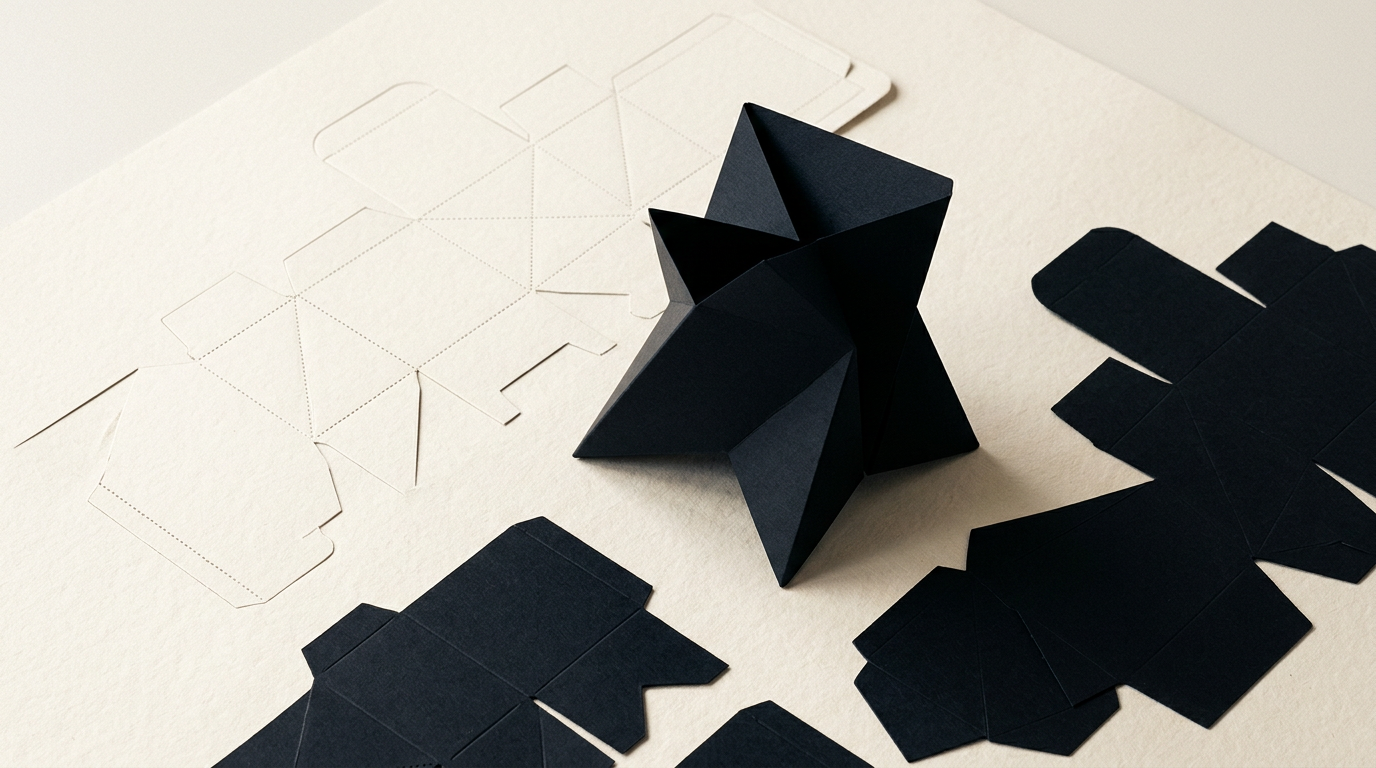
Producing professional packaging requires a precise transition from visual concepts to technical print execution. Without an accurate die-line and a well-structured mockup, the risk of misfolded boxes or misaligned colors is huge. In this guide, I directly answer the most common questions regarding the packaging design and production workflow.
What exactly is a die-line and why isn't a simple drawing enough?
A die-line is a 2D vector file containing all technical dimensions, cut lines, fold (crease) lines, and perforation lines required to physically manufacture packaging. A simple drawing is not enough because printing machinery requires millimeter-exact coordinates for mechanical or laser cutting dies. If you submit a flat image or a sketch without technical layers, the cutter will slice randomly through your graphics. In professional design grafic services, die-lines are built on special layers using Spot Colors set to Overprint. This allows the print house to isolate technical lines from printed artwork without affecting background colors.
What is the difference between a 3D mockup and a technical die-line?
A 3D mockup is a photorealistic visual simulation of assembled packaging, whereas a technical die-line is the flattened 2D engineering blueprint used directly in manufacturing. The mockup helps you and your clients preview product shelf appeal and ensure visual elements built during a creare logo process are clearly visible from every angle. Conversely, the die-line contains bleed margins (3-5 mm), glue flaps, and safety zones. Key differences include:
- 3D Mockup: Sales-oriented, built for websites, social media, and digital catalogs.
- Technical Die-line: Strictly production-oriented, built for print machinery and structural engineering.
- Mockups mask folding errors; die-lines prevent structural cardboard overlaps in production.
Why do print errors occur if I only send a 3D mockup to the printer?
Errors occur because a 3D mockup is merely a digitally rendered image containing no vector cutting coordinates. A print shop cannot import a JPEG or PNG file into a mechanical die-cutting machine. Without a 2D vector template, the printer must re-draw dimensions manually, leading to unexpected white borders, trimmed text, or boxes that fail to close tightly. Furthermore, visual alignment defined during a broader identitate vizuala project loses precision across side panels if seams are not mathematically calculated on the flat layout.
How do I prepare a packaging file to avoid financial losses?
Proper file preparation requires strictly separating technical elements from artwork and adhering to your specific print vendor's specs. An incorrect packaging file can ruin a production run of thousands of units and thousands of euros. To prevent these unnecessary costs, ensure you follow this pre-flight checklist:
- Define all cut lines using a dedicated Spot Color named explicitly "Die Cut".
- Separate crease (fold) lines using a dashed line style and a distinct color from cut lines.
- Extend background artwork at least 3-5 mm past the outer cutting line for bleed.
- Keep critical text and branding elements at least 3 mm away from fold lines.
- Convert all fonts to outlines and work exclusively in the CMYK color space.
How long does an original die-line take compared to a standard template?
Adapting artwork onto a standard template supplied by a printer takes 1–3 business days, while designing a custom die-line from scratch takes 5 to 10 business days. Custom structural packaging requires physical prototyping, material stress testing, and iterative adjustments to locking flaps. If you are launching a new product and need fast web promotion on a site de prezentare, using a standard FEFCO or ECMA template reduces time-to-market and eliminates physical tooling fees, which can range from €150 to €600.
How do I test a physical mockup (prototype) before mass production?
Testing a blank physical prototype (plotter sample) is the critical phase where you evaluate ergonomics, structural integrity, and exact product fit. Never approve mass printing without holding at least one unprinted sample cut from the final paperstock on a plotter. You can inspect real project samples in my portofoliu section to see how flat blueprints translate into finished items. When reviewing physical prototypes, check these details:
- Insert the physical product to verify if there is excess slack or if pressure tears the paperboard.
- Open and close top/bottom flaps 10-15 times to test board fiber resistance against cracking.
- Ensure locking mechanisms snap flush without requiring manual forcing.
Why is packaging optimization important for AI search engines and e-commerce?
How your packaging is presented digitally directly impacts product discoverability across visual search tools and modern AI search assistants. When publishing 3D mockups on your online store, image assets must be optimized with structured data and clear alt attributes. Implementing optimizare GEO / AEO / AIO strategies for your product assets helps AI search tools correctly identify packaging specs, ingredients, or features, directly recommending your brand when users search for relevant products.
How do paperstock selection and special finishes affect the die-line?
Paperstock thickness and flute type (from 350g folding boxboard to E-flute or B-flute corrugated board) directly alter required distances between fold lines. Thicker materials require larger folding allowances (crease offset), otherwise boxes buckle or tear at corner joints. Special finishes like hot foil stamping, spot UV varnish, or embossing require dedicated vector layers within the technical file. Without these explicit specifications on the die-line, premium finishes risk shifting 1-2 mm out of registration during press runs.
What's next?
Designing packaging that stands out on retail shelves and assembles effortlessly on production lines requires combining creative design with mechanical precision. If you need expert help creating error-free die-lines, realistic 3D mockups, or a complete packaging design solution, reach out via my contact page. Let's turn your concept into a print-ready product ready for retail.