5 min read
Packaging Die-lines and Mockups: How to Go From Plan to Product?
Learn how to turn a technical die-line and a 3D mockup into a shelf-ready package. A practical guide with technical tips and real-world costs.
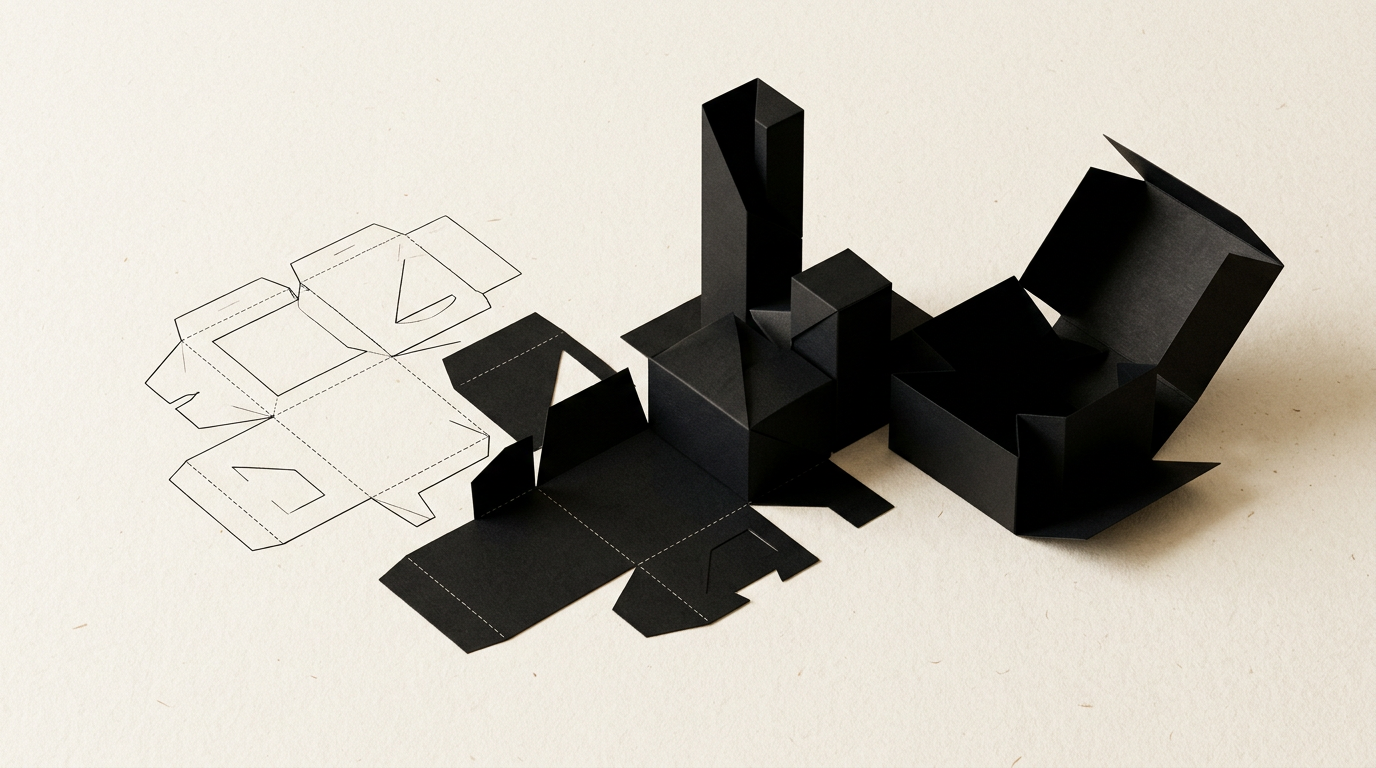
Bringing packaging from concept to store shelves requires a rigorous technical workflow where design meets print engineering. Without a correctly folded structure and a precise visual simulation, production risks at the printing house increase exponentially. In this practical guide, we examine the essential roles that die-lines and mockups play in launching an unblemished product package.
What exactly is a die-line and why do I need it before graphic design?
A die-line is the two-dimensional flat template of a package, marking exact cut lines, fold lines, glue areas, and safety margins. It is effectively the technical blueprint onto which the graphic designer places all visual elements. Without this precise framework, a designer risks placing critical text over a fold or submitting an un-assemblable file to print. When delivering graphic design services for packaging, I always request or build the die-line before positioning the first visual element. Cut lines are set up as a spot color (usually solid red), while fold lines use another color (dashed blue), both set to Overprint so they don't print onto the final CMYK plates.
What is the difference between a 3D digital mockup and a physical prototype?
A 3D digital mockup is a photorealistic computer simulation of the final product, whereas a physical prototype is a printed and assembled sample made from actual cardstock. Both serve distinct roles in the packaging production and approval workflow:
- 3D Digital Mockup: Used for graphic approvals, e-commerce product renders, marketing presentations, and testing visual appeal prior to manufacturing.
- Physical Prototype (unprinted white sample or digitally printed mock-up): Verifies structural integrity, flap closures, internal fitting, and how the paperboard behaves when folded.
While a digital render validates aesthetic balance, only a physical prototype guarantees that a box supports a 500g load or that a professional logo remains fully visible once the top flap is secured.
Who provides the die-line: the designer or the print house?
Ideally, the die-line is provided by the printing house executing the job, as they know their exact machinery, paperboard thickness, and required tolerances. However, if you are developing a custom or atypical box shape from scratch, a specialized packaging designer can draft the CAD layout. Paperboard caliper (ranging from 300 gsm folding boxboard to rigid board or CO3/CO5 corrugated cardboard) directly dictates internal and external dimensions. Changing paper stock from 0.4 mm to 1.5 mm without adjusting the die-line will prevent the box from closing properly. I always cross-check technical files in my portfolio with print engineers before declaring a file print-ready.
What technical mistakes happen most often when preparing a die-line for print?
Most technical mistakes stem from a lack of clear technical communication between designer and printer, leading to costly waste on large print runs. The most common errors include:
- Missing bleed allowance: Artwork stops precisely at the cut line, creating ugly white fringes if the steel die shifts by even 0.5 mm.
- Failing to set die lines to Overprint / Spot Color: Technical lines get printed directly over the final package graphics.
- Ignoring paperboard grain direction: Folding against the grain causes cracks in the paper fibers and protective varnish.
- Placing text too close to creases: Regulatory text or barcodes end up partially tucked under fold flaps.
Preventing these flaws requires strict vector inspection and proper derivation from the brand's overarching visual identity.
How much does a packaging die-line and 3D mockup cost?
Structural die-line development and photorealistic 3D mockup creation typically cost between €150 and €500 per SKU, depending on box complexity. Printing houses often provide standard die-lines (such as FEFCO or ECMA catalog shapes) for free, but custom shapes requiring load calculations and custom locking mechanisms require specialized engineering hours. The physical steel cutting die (a custom wooden block with metal blades) is charged separately by the printer, costing between €80 and €300 as a one-time tooling investment. For e-commerce brands launching a presentation website or online shop, investing in 3D renders pays off quickly by eliminating expensive studio photo shoots.
How does a 3D mockup help with marketing and e-commerce?
A photorealistic 3D mockup allows you to launch marketing campaigns and pre-sell products long before physical manufacturing finishes at the print shop. Instead of waiting weeks for production runs and hiring photo studios, you can generate 4K resolution images from perfect angles with controlled lighting. Furthermore, clean 3D assets can be structurally optimized for digital platforms using GEO / AEO / AIO optimization strategies, making them easily indexable by visual search engines and AI assistants. 3D mockups offer complete flexibility: you can swap backgrounds, tweak colors, or adjust flavor variants in minutes while maintaining pristine visual consistency.
What must the final print-ready file for packaging contain?
The final print-ready file (Pre-press PDF) should be delivered in vector PDF/X-4 format, layered, with all typography outlined to curves. The technical die-line layer must be completely isolated from the artwork layer and assigned a dedicated Spot Color set to Overprint. All embedded raster images require a minimum resolution of 300 DPI at a 1:1 scale, and color spaces must be configured strictly in CMYK or specific Pantone codes—never RGB. Additionally, the file must include at least 3 mm of bleed beyond the cut lines and a minimum internal safety margin of 3–5 mm for critical text and logos.
What's next?
Launching flawless packaging demands more than eye-catching graphics; it requires technical precision from initial die-line to final pre-press prep. If you want to turn your packaging concept into a shelf-ready product without risking expensive production errors, feel free to reach out directly. From graphic layout and photorealistic 3D renders to technical pre-press validation, I offer end-to-end packaging design services. Visit the contact page to discuss your project details and get a clear estimate on timeline and costs.